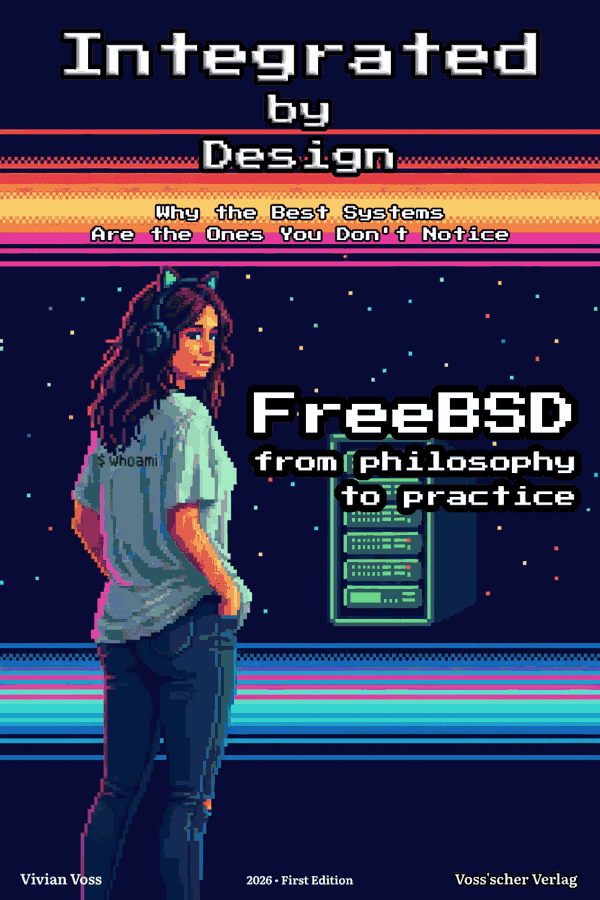
Vivian Voss
System Architect & Software Developer.
37 years in the game. 26 professionally.
Building minimal tools that earn every byte.
Inspired by the demoscene. Guided by Unix philosophy.
Using AI to engineer, educate and validate, not to replicate the bloat faster.
What I Do
I design systems where reduction is the method, not the compromise.
Small binaries. Semantic markup. Honest interfaces.
Every abstraction must justify its weight.
Currently Senior Developer at a German DIY wholesale giant,
working with React, TypeScript, and Spryker. Privately building
small tools for testing ideas,
ultralight and rooted in demoscene constraints.
Focus
System architecture, performance engineering, and the frontend
that sits on top of both. Full-stack, if you must; I prefer
to call it taking responsibility for the whole path.
The common thread is root cause over symptom: I would rather
remove the reason a system is slow than buy hardware to
outrun it.
I keep a German-language record of how that diagnosis is done, at
advisor.vivianvoss.net:
what gets measured, what a written finding contains, and where the
system boundary is drawn. It documents a way of working rather than
an offer; I take no mandates.
Three Series, One Argument
The writing here runs in three parallel series:
Lean Software, on building less and getting more;
Unix Universe, on the operating systems that
outlived their critics; and IT Philosophy, on why
we keep making the same expensive mistakes. Different
angles, same argument: complexity is a cost, not an
achievement.
The Hardware Trail
1989 ■ Amiga 500
1992 ■ Atari Mega STE
1994 ■ 486 DX2/66
1996 ■ Unix/Linux
1996 ■ Matrox Millennium
1998 ■ 3dfx Voodoo2
2000 ■ First paycheck for code
2000 ■ IBM ThinkPad
2008 ■ MacBook Pro
Rust■
C■
Java■
Python■
Swift■
HTML■
CSS■
JavaScript■
TypeScript■
Tcl/Tk■
PHP■
Lua■
sh■
FreeBSD■
Linux■
BeOS■
QNX■
AS/400■
BASIC■
Pascal■
Rust■
C■
Java■
Python■
Swift■
HTML■
CSS■
JavaScript■
TypeScript■
Tcl/Tk■
PHP■
Lua■
sh■
FreeBSD■
Linux■
BeOS■
QNX■
AS/400■
BASIC■
Pascal■
Series
vivian@vivianvoss:~ $ tree -L 2 /series26 series · 285 dispatches
Latest Writing
8 Oct
it philosophy
security
freebsd
Every hardening guide says so, and every guide is right: the money it wastes is the scanner's. Under five minutes for one port across IPv4, about 227 days for all of them. A server followed from the street inwards, where only the gate is obscurity and everything behind it is mechanism.
7 Oct
lean software
freebsd
bectl
Five ways back from one upgrade, 147 MB, four of them laid by freebsd-update without being asked. A Debian server keeps two kernels. On FreeBSD the next system can be upgraded as a jail and tried once, with the power switch as the way back.
6 Oct
like for like
freebsd
zfs
A Linux kernel developer told a ZFS user to switch to FreeBSD. On Debian every kernel update compiles 368,777 lines of ZFS on the server, and the newest kernel waited 38 days at the median for a ZFS release that supports it. On FreeBSD, ZFS has shipped with the kernel since 2008.
5 Oct
unix universe
freebsd
jails
A FreeBSD jail is one kernel object with no daemon behind it; Docker assembles the same fence from eight namespaces and four further mechanisms with 258,735 lines. Both cost nothing at runtime. A thin jail ships as a ZFS snapshot through a pipe, its database included, and eight of ten isolation jobs are jail jobs.
3 Oct
bytes of art
demoscene
software rendering
Demozoo lists the Italian Bad Boys as disbanded, no releases since 1995. In June one of them came back, alone in every credit field, and won the demo competition at the first new Italian demoparty for twenty years. The demo renders on the processor.
All articles →
This Page Right Now
No framework. No build step. Measured live in your browser. Pure CAST Daemon.
---
TTFB
---
FCP
---
LCP
0 ms
TBT
---
CLS
---
Transfer Size
The numbers above are measured live in your browser: your connection,
your device, no averages. Below is what Google thinks of the result.
Lighthouse
audits four dimensions: raw speed, semantic accessibility,
security and API hygiene, and search engine visibility.
Four perfect scores from a self-made Rust binary web server with zero dependencies.
Google Lighthouse. Measured on vivianvoss.net,
this site, served by CASTD — an extremely fast self-made
and full scale web and content server written in pure Rust with zero dependencies.